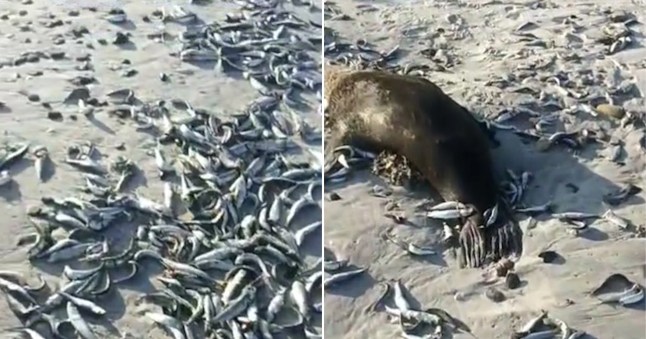
Thousands of dead fish were spotted across a beach in South Africa (Picture: @777nitro/Newsflash/NX)
Scientists have launched an investigation after thousands of dead fish mysteriously washed up along beaches in South Africa.
Disturbing footage shows dead pilchards,which belong to the herring family and are generally slightly larger than sardines,covering large sections of Bloubergstrand Beach in Cape Town on Monday,August 17.
Several birds can also be seen nearby,with some appearing to be unwell.
The mass deaths have also been reported at Milnerton and Sunset Beach,with dead pilchards found on the shore along parts of the wider Cape Town coastline.
Scientists have detected genetic material from the virus pilchard herpesvirus (PHV) in samples taken from the dead fish.
The Department of Forestry,Fisheries and the Environment (DFFE) said the virus was also found at lower levels in some apparently healthy sardines caught off the west coast.
Sign up for all of the latest stories
Start your day informed with Metro's
News Updates newsletter or get
Breaking News alerts the moment it happens.However,officials have stated that this does not mean the virus caused the deaths.DFFE spokesperson Zolile Nqayi said: ‘Sequencing has confirmed the presence of PHV genetic material but this alone does not prove that the virus caused the deaths.’The virus is understood to affect the gills of fish,making infected sardines less able to breathe and more vulnerable to low oxygen levels or sudden changes in sea temperature.Scientists are also investigating a number of other possible causes,including harmful algae,low oxygen levels,unusual ocean conditions and changes in water temperature.The DFFE said PHV had never previously been recorded in South African sardines.However,the virus has been linked to major sardine deaths in Australia and New Zealand back in the 1990s.
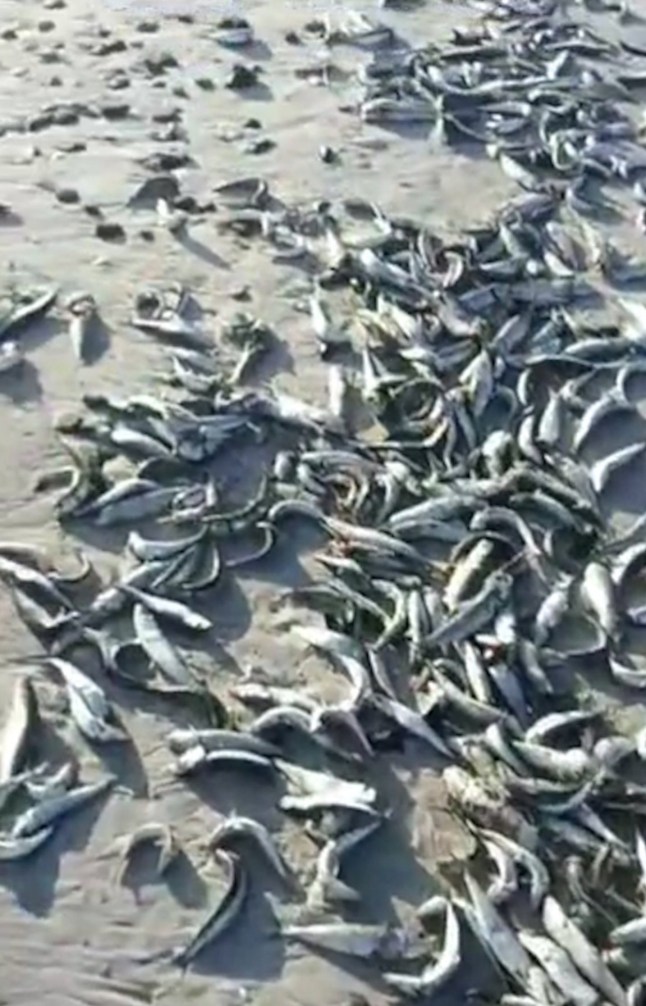
(Picture: @777nitro/Newsflash/NX)The disappearance of thousands of sardines has also sparked fears for South Africa’s critically endangered penguins which rely on sardines and anchovies for food.Marine biologists said penguins at three local breeding colonies had already shown signs of weight loss.Authorities have also urged members of the public not to collect or eat fish that have washed up dead.The DFFE warned that dead marine animals can pose health risks because bacterial contamination can occur.The warning does not,however,apply to commercially produced canned sardines.